Table of Contents
What Is a Supply Chain?
A supply chain is the complete network of organizations, people, activities, information, and resources involved in moving a product or service from its raw material source to the final customer. It encompasses every step required to create, store, transport, and deliver products to those who need them.
A typical supply chain includes:
- Suppliers and raw material providers — who provide the basic inputs
- Manufacturers or production facilities — who transform materials into products
- Warehouses and distribution centers — who store inventory strategically
- Transportation and logistics partners — who move goods between locations
- Retailers, wholesalers, or end customers — who purchase and use the products
The supply chain extends far beyond physical product movement. It also manages the flow of information (such as demand forecasts, inventory levels, and order status) and the flow of money (including payments, invoicing, and cost management). When these three flows — physical, informational, and financial — work together smoothly, products reach customers at the right time, in the right place, and at competitive prices.
Real-World Supply Chain Examples by Industry
Retail Clothing: Cotton farms → Textile mills → Garment factories → Distribution centers → Retail stores → Customers. This supply chain often spans multiple countries and involves complex coordination between suppliers across different continents.
Food & Beverage: Farms → Processing facilities → Packaging plants → Cold storage warehouses → Grocery stores → Consumers. Requires strict temperature control, short lead times, and careful management to prevent spoilage.
Automotive: Raw material suppliers (steel, rubber, electronics) → Parts manufacturers → Assembly plants → Dealerships → Car buyers. A single vehicle contains thousands of parts from hundreds of suppliers, requiring precise just-in-time coordination.
E-Commerce: Multiple suppliers → Fulfillment centers → Last-mile delivery partners → Customers' homes. E-commerce supply chains prioritize speed and convenience, with same-day or next-day delivery expectations becoming the norm.
What Is Supply Chain Management (SCM)?
Supply Chain Management (SCM) is the strategic coordination and optimization of all activities involved in sourcing, procurement, conversion, and logistics management. While the supply chain represents the physical network, SCM is the discipline of actively planning, executing, controlling, and monitoring these activities to create value and build competitive advantage.
Effective supply chain management helps organizations answer critical business questions:
- Sourcing decisions: What should we buy, and from which suppliers?
- Inventory decisions: How much inventory should we hold, and where should it be located?
- Production decisions: What should we produce, when, and in what quantities?
- Distribution decisions: How and when should products be delivered to customers?
- Risk management: How do we prepare for supply disruptions and demand fluctuations?
SCM in Practice: Industry Examples
Fast Fashion Retail: Leading fast fashion companies design and deliver new clothing lines in just 2–4 weeks. Their SCM focuses on speed and flexibility, using real-time sales data to quickly adjust production and distribution.
Pharmaceutical Industry: SCM in pharmaceuticals prioritizes compliance, quality control, and traceability. Temperature-controlled storage, expiration date tracking, and regulatory documentation are critical.
Technology Manufacturing: High-tech supply chains manage complex global networks with hundreds of specialized suppliers. They balance innovation speed with cost efficiency, often launching new products simultaneously worldwide.
Companies with strong SCM can reduce operational costs by 15–20%, improve delivery reliability by 30–50%, and respond to market changes 3–5 times faster than competitors.
The mechanism that makes cross-functional coordination happen is Sales & Operations Planning (S&OP) — a structured monthly governance cycle where demand, supply, inventory, and finance teams align on a single consensus-driven operating plan. As organizations mature, S&OP often evolves into Integrated Business Planning (IBP), which connects operational plans to corporate strategy and financial budgets. Explore our S&OP Guide and IBP Guide for more.
The Three Main Flows in the Supply Chain
Think of the supply chain as the management of three key flows that move across organizations and partners. Problems in one flow often impact the others.
Physical Flow
The physical flow refers to the movement and storage of goods throughout the supply chain — transportation of raw materials, movement of finished products, and storage of inventory at different locations. It also includes reverse flow: returns, repairs, recycling, and product disposal.
Information Flow
The information flow is the data that supports planning, coordination, and decision-making: customer demand and sales data, inventory levels, production schedules, order status, and delivery tracking. Without accurate and timely information, supply chain decisions become guesswork.
Financial Flow
The financial flow represents the movement of money: payments to suppliers, customer invoices and collections, transportation and warehousing costs, and cash flow and working capital management. Managing the financial flow effectively helps control costs and maintain financial stability.
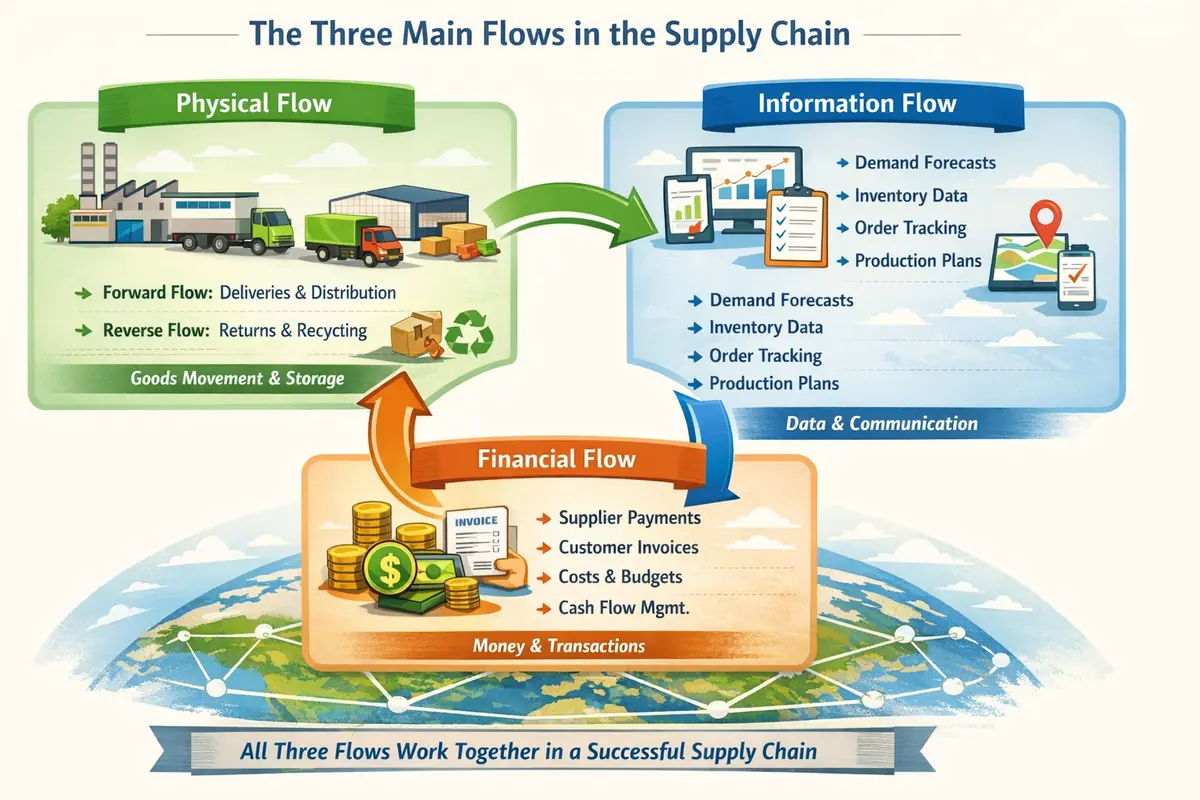
Figure: The Three Main Flows in the Supply Chain
The Core Functions of the Supply Chain
The supply chain is made up of several core functions that work together to move products from suppliers to customers:
- Procurement — sourcing and buying goods and services
- Inventory management — controlling how much stock is stored and where
- Demand planning — forecasting future customer needs
- Production and operations — transforming materials into finished products
- Delivery and logistics — moving products to customers
Beyond day-to-day coordination, supply chain leaders make fundamental design choices. One important decision is whether to run a push system (producing based on forecasts) or a pull system (producing only in response to confirmed customer orders). Closely related is the strategic choice between a lean supply chain (focused on waste elimination), an agile supply chain (focused on speed and responsiveness), or a leagile hybrid. See our guides on Push vs Pull Systems and Lean vs Agile vs Leagile for more detail.
What Is Procurement?
Procurement is the process of sourcing, selecting, and acquiring the goods and services a company needs to operate. It goes beyond simply buying products — it includes:
- Identifying reliable suppliers
- Negotiating prices, contracts, and terms
- Ensuring quality and compliance
- Managing long-term supplier relationships
The goal of procurement is to secure the right products or services, at the right quality, cost, and time, while reducing supply risk. Strong procurement practices help companies control costs and ensure continuity of supply.
For the cost side of procurement decisions, see our Procurement Costs Guide, which covers total cost of ownership (TCO), supplier comparison frameworks, and sourcing savings analysis.
Procurement vs Purchasing: What's the Difference?
Procurement and purchasing are closely related, but they are not the same.
Procurement is a strategic, long-term activity. It focuses on where to buy, who to buy from, and under what conditions — including supplier selection, contract negotiation, and risk management.
Purchasing is an operational activity. It focuses on executing the purchase: placing orders, receiving goods, and processing payments. Purchasing is a part of the broader procurement process.
What Is Inventory Management?
Inventory management is the systematic process of ordering, receiving, storing, tracking, and controlling stock levels throughout the supply chain. It is one of the most critical aspects of SCM because inventory represents both a necessary asset and a significant cost for most businesses.
Inventory typically falls into four main categories:
- Raw materials: Unprocessed materials awaiting production
- Work-in-progress (WIP): Partially completed products in the manufacturing process
- Finished goods: Completed products ready for sale
- MRO: Spare parts, tools, and consumables needed to keep operations running
The fundamental challenge is achieving the optimal balance:
- Excess inventory increases carrying costs, ties up working capital, and creates obsolescence risk
- Insufficient inventory causes stockouts, lost sales, production delays, and emergency expediting costs
Industry-Specific Inventory Challenges
Grocery Retail: Must manage thousands of SKUs with varying shelf lives — a typical supermarket turns over perishable inventory 50+ times per year while turning dry goods only 12 times annually.
Electronics Manufacturing: Faces rapid product obsolescence — components can become outdated in 6–12 months while component lead times stretch 8–16 weeks.
Furniture Retail: Deals with bulky, slow-moving inventory with only 4–6 inventory turns per year, making each purchasing decision critical.
Effective inventory management can reduce total inventory costs by 20–35% and improve customer fill rates from 85% to 95%+. For the full cost picture, see the Inventory Costs Guide.
Key Inventory Management Concepts
Safety Stock
Safety stock is extra inventory kept to protect against uncertainty, such as demand fluctuations or supplier delays. It acts as a buffer to reduce the risk of stockouts. Our Safety Stock Guide covers the statistical methods for calculating buffer stock under demand and lead time uncertainty.
Lead Time
Lead time is the time between placing an order and receiving the goods. Longer or unpredictable lead times usually require higher safety stock levels. See the Lead Time Analysis Guide for details on measuring and reducing lead time variability.
Reorder Point
The reorder point is the inventory level at which a new order should be placed — designed to ensure new stock arrives before existing inventory runs out. The Reorder Point Guide explains how to set replenishment triggers. The EOQ Guide shows how to calculate optimal order sizes.
For a broader perspective on inventory strategy, the Inventory Analysis Methods guide covers frameworks like ABC-XYZ classification that help segment your product portfolio and apply the right stocking policy to each category.
What Is Demand Planning?
Demand planning is the process of estimating future customer demand so that the supply chain can be prepared to meet it. It helps companies decide how much to produce or buy, how much inventory to hold, and where inventory should be located.
Demand planning uses historical sales data, market trends, seasonality, promotions, and business knowledge. The goal is not to predict demand perfectly, but to reduce uncertainty and make better supply chain decisions.
Demand Planning vs Demand Forecasting
Demand forecasting focuses on predicting future customer demand, usually using historical data and statistical models. It answers the question: how much do we expect customers to buy?
Demand planning uses demand forecasts as an input, but goes further. It considers business constraints, supply capabilities, inventory policies, and strategic goals to decide how the supply chain should respond to demand.
For quantitative forecasting skills, our Demand Forecasting Methods Guide covers statistical approaches and accuracy metrics. For a structural comparison of both disciplines, see the Forecast vs Demand Planning Guide.
What Is Delivery Management?
Delivery management is the process of planning, executing, and monitoring how products are delivered from warehouses, factories, or distribution centers to customers. It includes selecting transportation modes and carriers, planning delivery routes and schedules, tracking shipment status, and managing delivery performance and costs.
The main objective is to ensure products arrive on time, in the right condition, and at the lowest possible cost. Delivery performance has a direct impact on customer satisfaction.
Logistics and Distribution in the Supply Chain
Logistics refers to the coordination of transportation, warehousing, and inventory movement across the supply chain. It focuses on how goods are moved and stored efficiently.
Distribution is the part of logistics that deals specifically with moving finished products from distribution centers to customers or retail locations.
Together, logistics and distribution support faster order fulfillment, lower transportation and storage costs, better inventory availability, and improved customer experience.
How Supply Chain Functions Work Together
Supply chain functions do not operate independently. Each function is connected, and decisions made in one area directly affect the others:
- Demand planning estimates future customer needs
- Procurement uses this information to source materials and products
- Inventory management determines how much stock to hold and where
- Delivery management ensures products reach customers on time
If demand planning is inaccurate, procurement may buy too much or too little. If inventory levels are poorly managed, delivery performance may suffer. Supply chain success depends on coordination and alignment across all functions.
Why Supply Chain Management Matters for Businesses
Effective supply chain management helps companies:
- Reduce operational and transportation costs
- Improve customer service and delivery reliability
- Avoid stock shortages and excess inventory
- Improve cash flow and working capital
- Respond more effectively to demand changes and disruptions
In many industries, supply chain costs represent a large share of total business expenses. Small improvements in planning, inventory, or delivery can therefore have a significant financial impact.
To know whether your supply chain is effective, you need the right metrics. Our Supply Chain KPIs & Metrics Guide covers indicators like inventory turnover, fill rate, OTIF, forecast accuracy, and cash-to-cash cycle time with formulas and industry benchmarks.
How Supply Chains Differ Across Industries
While all supply chains share common principles, their design and priorities vary significantly based on product characteristics, customer expectations, and industry dynamics.
Key Differentiating Factors
Product Perishability: Fresh food supply chains require hours or days; durable goods supply chains can plan months ahead.
Product Value Density: High-value, small items (jewelry, electronics) can absorb air freight; low-value, bulky items (furniture, beverages) require regional distribution and cost-focused optimization.
Demand Predictability: Stable demand allows efficient, cost-optimized supply chains; unpredictable demand requires agile supply chains with speed over cost.
Comparative Industry Benchmarks
| Industry |
Priority |
Lead Time |
Inv. Turns/Year |
Key Challenge |
| Grocery Retail |
Freshness & availability |
1–3 days |
15–50 |
Minimizing waste & stockouts |
| Automotive |
Quality & coordination |
30–90 days |
8–12 |
Managing 1000s of suppliers |
| Fast Fashion |
Speed to market |
14–30 days |
6–10 |
Trend responsiveness |
| Pharmaceuticals |
Compliance & traceability |
60–120 days |
4–8 |
Regulatory requirements |
| E-Commerce |
Delivery speed & convenience |
1–2 days |
12–25 |
Last-mile delivery costs |
| Construction |
Project coordination |
7–45 days |
3–6 |
Site-specific delivery timing |
Case Study: Supply Chain End-to-End — Specialty Coffee Company
To bring all these concepts together, let's examine a complete, end-to-end supply chain example. This case study illustrates how theory translates into practice and how different supply chain functions interconnect in a real business.
Company Background
A medium-sized specialty coffee company based in the Midwest United States sources high-quality arabica coffee beans from farms in Colombia, Ethiopia, and Guatemala, roasts them at their facility, and distributes to 200+ retail locations across the region, plus direct-to-consumer online sales.
Annual volume: 500,000 kg of roasted coffee | Revenue: $12 million | Employees: 45 full-time
Stage 1: Procurement (Green Coffee Beans)
The procurement manager works with coffee cooperatives and importers from three origin countries, visiting farms annually to assess quality. Key activities include supplier selection based on quality scores, sustainability certifications, price, and reliability; 12-month fixed-price contracts to hedge against commodity price volatility; and quality control involving sample roasting and cupping before acceptance.
Key challenge: Coffee harvests are seasonal (typically October–March in Colombia). The company must purchase sufficient green coffee during harvest season to last until the next crop — green beans remain fresh 12–18 months in climate-controlled storage, creating a natural inventory cycle.
Stage 2: Inventory Management (Green Coffee)
The company maintains a climate-controlled green coffee warehouse with capacity for 100,000 kg of beans:
- Safety stock: 75,000 kg (8 weeks) to protect against shipping delays and demand surges
- Reorder point: Triggers new purchase orders when inventory drops to 120,000 kg
- Inventory turns: 6 times per year | Average coverage: 60 days | Carrying cost: 18% annually
Stage 3: Demand Planning & Forecasting
The demand planner uses 24 months of sales history with seasonal adjustments (sales spike 40% in November–December), collaborates monthly with top 20 retail accounts on promotional plans, and monitors online order trends weekly.
- Overall MAPE: 78% at SKU level, 88% at aggregate level
- New product forecast accuracy: 65% (typical for new items)
Stage 4: Finished Goods Inventory
The company manages 15 SKUs using ABC classification — top 5 SKUs (A items) represent 70% of sales. Safety stock policy: A items 2 weeks, B items 3 weeks, C items 4 weeks. Strict FIFO rotation to ensure freshness.
- Inventory turns: 18 times per year | Average coverage: 20 days | Fill rate: 94%
Stage 5: Distribution & Delivery
B2B (80% of volume): Company-owned delivery trucks for local metro area, third-party LTL carriers for regional deliveries. Route optimization software reduces miles driven and improves delivery density.
DTC (20% of volume): Regional 3PL provider for pick, pack, and ship. 96% on-time delivery rate, 1.5% damage rate.
- B2B delivery cost: $0.12/kg | DTC delivery cost: $0.45/kg | Total transport as % of revenue: 6%
Supply Chain Improvements & Financial Impact
Over two years, the company improved forecast accuracy from 72% to 78% by collaborating with retailers, added backup suppliers (improving supply reliability from 88% to 94%), reduced finished goods inventory by 22% through ABC segmentation, and cut B2B delivery costs by 18% through route optimization.
Result: Gross margin improved from 38% to 42%; $180,000 freed up in working capital.
Key Supply Chain Lessons
- Integration matters: Supply chain functions don't operate in isolation — decisions in procurement affect inventory, which affects delivery.
- Trade-offs are unavoidable: Balance freshness (lower inventory) against service reliability (higher inventory).
- Data drives decisions: Forecast accuracy, inventory turns, fill rates, and cost metrics guide continuous improvement.
- Supplier relationships matter: Long-term partnerships provide supply security that purely transactional relationships cannot.
- Small improvements compound: Multiple 10–20% improvements in different areas combined to significantly improve overall profitability.
Continue Your Learning: Deep-Dive Guides
The fundamentals above provide the foundation every supply chain professional needs. To develop deeper expertise, our specialized guides take each topic further with frameworks, formulas, worked examples, and actionable advice.
📦 Inventory & Stock Management
📊 Demand Planning & Forecasting
🤝 Procurement & Sourcing
📋 Planning Processes & Strategy
🎯 Reference & Career
For the most structured learning experience, we recommend starting with the inventory guides (safety stock, EOQ, reorder point), then demand forecasting, then planning process guides (S&OP, IBP), and finally the strategic design frameworks. Or follow the Learning HUB guided paths.